
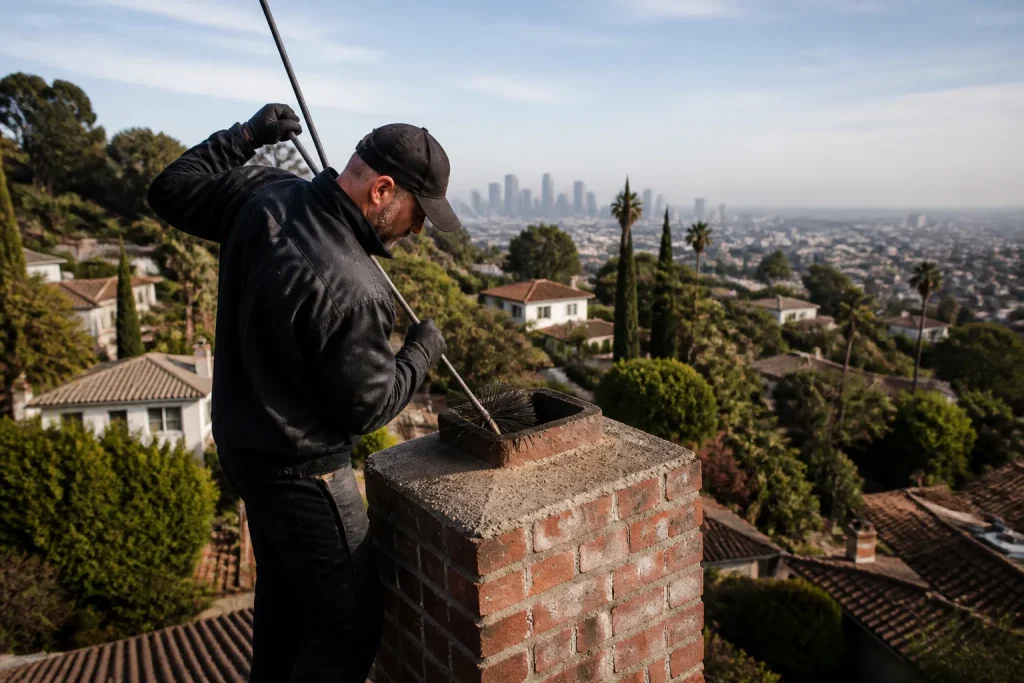
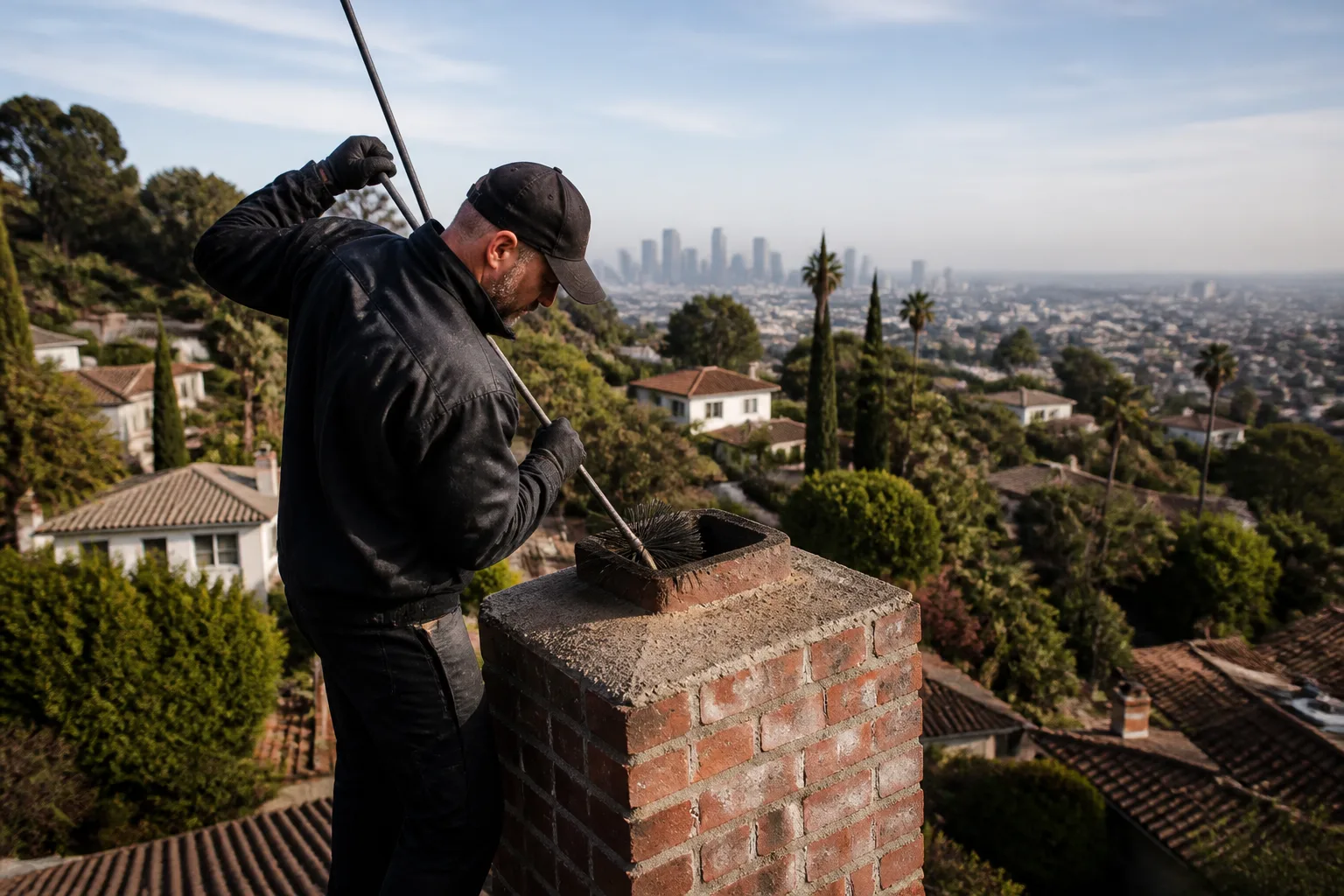
Chimney Sweep: Repair or Replace? How Los Angeles Homeowners Decide
The repair-or-replace decision on a chimney almost never happens at the point of failure. It happens at the inspection, when a contractor tells you what they saw. In Los Angeles, a full flue relining job typically runs $2,500 to $5,000, while a ceramic sealant repair on the same liner runs $900 to $1,800. Most homeowners receive a recommendation for the expensive option without ever seeing the inspection video or report that supposedly justifies it. That is the actual problem. If you’d rather not deal with any of this yourself, call us at (830) 251-4560 and we’ll walk you through what we found, on camera, before you spend a dollar.
Every chimney has maybe eight components that wear out. Some of them can be repaired. Some cannot, and trying to repair them is throwing money into a hole in your roof. The difference is knowable, and it has very little to do with what the contractor thinks. It has everything to do with what the inspection shows, in writing.
Key takeaways:
- Flue liners, crowns, flashing, dampers, and fireboxes each have a different “repair or replace” threshold.
- The National Fire Protection Association’s NFPA 211 is the standard that defines those thresholds. Ask your inspector to cite it by name.
- In Los Angeles, earthquakes, marine air, and years of disuse each degrade chimney components in specific, predictable patterns.
- Any repair recommendation that is not backed by camera footage or images you can see yourself is a sales pitch, not an inspection result.
The Component-by-Component Decision Framework
Not every chimney part deserves the same treatment. Some can be patched, sealed, or rebuilt. Others need full replacement, and no amount of sealant is going to save them. The National Fire Protection Association’s NFPA 211 standard gives the industry the thresholds, but it helps to know them before anyone comes out to your house in Los Angeles.
- Flue liner (the inner channel that carries smoke and exhaust out): This is the most expensive component, and the one most likely to be oversold. Minor cracks and spalling in clay tile liners can sometimes be repaired with a ceramic sealant system. HeatShield and similar products are specifically designed for this application, and they can restore a liner’s smoke-tightness without full replacement. But the operative word is sometimes. If the liner has collapsed, if sections have shifted out of alignment, or if the mortar joints have eroded to the point where tiles are loose, you are past sealing. Full relining is required.
- Chimney crown (the concrete cap at the top of the stack): A crown with hairline cracks can be sealed. A crown that has crumbled, spalled, or separated from the flue needs to be re-poured. There is no middle option that lasts. Los Angeles sees a surprising amount of crown damage, mostly from thermal cycling, and any crown work is a lot cheaper than letting water into the masonry below it.
- Flashing (the metal where the chimney meets the roofline): Most flashing failures in Los Angeles are not wear failures. They are installation failures. If the flashing is torn, corroded through, or separated due to roof movement, replacement is the answer. Patch and seal jobs on flashing rarely survive a Southern California winter and spring.
- Damper (the metal plate that seals the chimney when the fireplace is not in use): Dampers are mechanical hardware. They warp, rust, and stop seating. When the sealing surface is intact, a replacement damper is a straightforward repair. When the surrounding frame or the throat has deformed, you are into more involved reconstruction. The threshold here is whether the new damper can actually seat against a clean, complete surface.
- Firebox (the interior chamber where the fire actually burns): Firebox repair is masonry work. Cracked firebrick can be replaced. Spalling across the entire firebox floor often means it is time for a rebuild. This is one of the least understood repair-or-replace calls, because a firebox that looks ugly is sometimes still functional, and a firebox that looks fine can have dangerous gaps behind the face brick.
This is the framework we use on every Chimney Inspection in Los Angeles, and it is the same framework you should expect from anyone who gives you a recommendation. If the contractor cannot tell you which component crosses which threshold, that is the information you actually need.
What a Credible Inspection Report Looks Like
Homeowners in Los Angeles routinely make a $3,000 repair decision based on a verbal opinion delivered at the kitchen table. That should not be acceptable, and NFPA 211 actually requires more. The standard defines three levels of inspection, and a Level II video inspection is the minimum you should accept before any repair-or-replace recommendation.
A defensible inspection report should include:
- Still images or video frames from the camera run, with the component labeled and the condition visible. If you cannot see the damage in the image, the recommendation is not supported.
- A direct statement of the condition found, in plain words. “Liner has a 14-inch crack at the 9-foot mark, visible in frame 11” is a finding. “Liner is badly deteriorated” is an opinion.
- A repair-or-replace recommendation tied to a specific NFPA 211 provision. The standard is public, and any legitimate chimney professional should be able to tell you which section applies.
- Measurements. Crest height, liner diameter, crown dimensions, joint spacing. These numbers matter when you are comparing quotes, because they tell each contractor exactly what they are bidding.
- An explicit statement of what is NOT wrong. This is the part competitors miss. A credible report tells you what passed inspection, not just what failed. It keeps the conversation honest.
Flint Chimney Sweep provides this level of documentation on every inspection in Los Angeles because the Flint Chimney Sweep home standard under The Garrison Standard puts everything in writing before any tool comes off the truck. That includes the price, the scope, and the full-year guarantee. You can read the report while you think about the recommendation, and you can call us back when you have decided.
Los Angeles-Specific Damage Patterns Most National Advice Misses
Most chimney advice is written for Ohio and Pennsylvania, where freeze-thaw cycles beat chimneys to death every winter. Los Angeles has a completely different degradation pattern, and if you read generic national content, you are going to miss the three factors that actually damage chimneys in this city.
First, seismic movement. Los Angeles sits in one of the most seismically active regions in the country, and a chimney is a tall, rigid masonry structure attached to a flexible wood-frame house. Every small earthquake, and there are dozens a year, applies lateral stress at the roofline. Flashing separates, mortar joints crack, and in some cases, the crown shifts. We have seen liner tiles displaced by nothing more than the cumulative effect of small tremors over a decade. This is also why chimney seismic strapping is a common recommendation in Los Angeles renovations, and a Level II inspection will check for it.
Second, marine air. Homes within about five miles of the coast, from the Palisades down through Redondo Beach, get salt-laden air that accelerates corrosion on metal components. Dampers rust faster here. Flashings pit and corrode. Stainless steel liners survive far longer than galvanized, which is why we specify DuraFlex or Olympia Chimney liners on Los Angeles relines near the coast. The material choice is not a matter of preference. It is a matter of chemistry.
Third, infrequent use degradation. A lot of Los Angeles fireplaces are never used. They are architectural. The damper stays closed, maybe for years. Summer heat bakes the interior, and any moisture trapped inside has nowhere to go. The result is exactly the kind of slow, interior deterioration that only shows up on a camera run. Homeowners are often surprised when the inspection reveals significant damage on a fireplace that has not been lit in five years, but that disuse is often the cause, not the protection.
If you are in Los Angeles, near the coast or in the Valley, the pattern of damage your chimney has is different from the national average. The repair-or-replace thresholds are the same, but the causes are local, and the solution has to account for that.
The Questions to Ask After Any Inspection
This is where homeowners in Los Angeles get taken. The inspection is done, the technician delivers the recommendation, and the homeowner has no idea what to ask next. Here are the specific questions that convert a sales pitch into a defensible recommendation.
- Show me the camera footage of this specific component. If the damage is real, it is visible. If it cannot be shown, you are operating on trust.
- Which NFPA 211 provision covers this condition? The standard is industry-wide, and a professional who cannot cite it is not giving a professional recommendation.
- Is this a safety issue right now, or a condition that will worsen? The distinction matters, and it affects the timeline. A cracked crown needs attention soon but is not an emergency. A shifted liner tile is a more urgent call. You need to know the difference.
- What is the remedy scope in writing? This means: the specific component, the specific material, the price, and the guarantee. Material brands matter too. At Flint, we use HeatShield for sealant repairs, DuraFlex for stainless relines, and Olympia Chimney and Famco products for caps and dampers. The brand is not a secret. It should be on the quote.
- What is not in scope? You want to know what the repair does NOT include, so there are no price moves at the door. The Chimney Repair in Los Angeles recommendation should state this plainly.
One real example from a few months back: we inspected a chimney over in Eagle Rock where a homeowner had been told she needed a $4,200 reline. The liner had a gap at the top tile joint, visible in our camera run. A HeatShield repair sealed it for just under $1,200. The reline would have technically solved the problem, but it was not necessary. The difference was the camera image, and the homeowner’s willingness to ask to see it.
When to Repair, When to Replace: A Decision Table
Here is the decision framework in one place. Use this when you are looking at your inspection report, whether it is from us or from anyone else in Los Angeles.
| Component | Repairable If… | Replace If… |
|---|---|---|
| Flue liner | Cracks are localized; tiles are still aligned; joints can be sealed | Tiles have shifted, collapsed, or the liner has separated |
| Crown | Hairline cracks; surface spalling limited to a few spots | Deep cracking, separation from flue, or missing sections |
| Flashing | Minor separation at one edge; caulk failure only | Corrosion through the metal; torn or missing sections |
| Damper | Warped plate but intact frame; serviceable seal surface | Rusted-through frame; deformed throat; cannot seat |
| Firebox | Localized firebrick cracks; mortar joint erosion only | Widespread spalling; gaps behind face brick; floor failure |
A note on the sealant repair versus relining question, because it comes up constantly in Los Angeles homes with older clay tile liners. Ceramic sealant systems like HeatShield work when the liner’s structural integrity is still there. They fill cracks and restore the gas-tight surface. They do NOT restore a liner that has lost its structural shape. If your inspection shows tiles that are cracked but still in position, sealant repair is a legitimate option, typically $900 to $1,800. If tiles have shifted, relining is the only option, and in that case you are looking at $2,500 to $5,000 with a stainless liner like DuraFlex. The camera tells you which case you are in.
What a Written Repair Scope Must Include to Protect You
In Los Angeles, the repair-or-replace decision is only as good as the paper behind it. If the fix fails in six months, you want the remedy in writing before you pay. Here is what the scope document should contain, and what we put in writing on every job under The Garrison Standard.
- Component addressed: Exactly what is being repaired or replaced. “Repair chimney” is not a scope. “Repair flue liner via HeatShield application, 12 feet, no relining” is a scope.
- Materials specified by brand and product: The scope should say DuraFlex, or HeatShield, or Gelco, or Olympia Chimney, or Famco, or Copperfield. Generic material language means the contractor is free to use whatever is cheapest on hand.
- Price agreed, in writing, before work begins: This is non-negotiable in our company. The number on the invoice is the number you approved.
- Guarantee terms, stated precisely: What is covered, for how long, and what happens if it fails. Our Done Right Promise on every repair covers the work for a full year, and a covered failure means we come back at no charge.
- Exclusion list: What the repair does not cover. If a future masonry crack is not covered, the scope should say so. The point is truth in writing, not fine print buried after the fact.
This is what separates a chimney company that stands behind its work from one that considers the job finished when the truck pulls away. Los Angeles homeowners who have been burned before, and there are plenty of them, spot the difference immediately.
When to call a pro: Any time a recommendation involves the flue liner, the firebox, or the crown, this is not a DIY repair. These are the parts of your chimney that hold fire and heat, and if they are not installed and sealed correctly, the risk is a chimney fire or carbon monoxide entry into the house. A chimney inspection is the cheapest insurance you can buy for a fireplace, and in Los Angeles, where chimneys sit unused for years at a time, the inspection is usually the first time anyone has looked at the system since it was built.
Related services in Los Angeles: Chimney Sweep in Los Angeles, Chimney Inspection in Los Angeles, and Chimney Repair in Los Angeles.
The Bottom Line
Repair or replace is a decision, not a gambit. The chimney components that matter each have a defined threshold, and that threshold is visible on a camera run. The homeowners who get taken are the ones who never ask to see the footage, never ask for the written scope, and never ask which NFPA 211 provision applies. The homeowners who do ask those questions end up paying for the work that was actually needed, not the work that was easiest to sell.
In Los Angeles, where earthquakes move masonry, marine air eats metal, and unused fireplaces rot quietly, the inspection is the entire basis of the decision. Get it in writing. Get it on camera. Get a guarantee that has teeth. If you’re in Los Angeles and need help with any part of this, Flint Chimney Sweep offers free estimates and written scopes on every job. Call (830) 251-4560.
Frequently Asked Questions
How often should a chimney be swept?
The NFPA 211 standard says a chimney should be swept when there is 1/8 inch or more of soot buildup, and the Chimney Safety Institute of America says anything more than 1/4 inch of creosote requires immediate action. In practice, a fireplace used regularly through a Los Angeles winter should be swept once a year. A fireplace that is never used still needs an inspection, because disuse creates a different set of problems.
How much does a chimney sweep cost in Los Angeles?
A standard chimney sweep in Los Angeles typically runs $180 to $320, assuming a single flue and no major access issues. The price goes up if you have not had the chimney serviced in years, if the creosote is heavy, or if an animal has built a nest in the flue. Any quote should be in writing before the work starts.
Can a cracked flue liner be repaired, or does it always need to be replaced?
A cracked flue liner can sometimes be repaired with a ceramic sealant system like HeatShield, which restores the gas-tight surface without full relining. This is a legitimate option when the liner tiles are cracked but still structurally aligned. If the tiles have shifted, collapsed, or separated, the liner’s structural integrity is gone, and replacement with a stainless liner like DuraFlex is the only safe course. The distinction is visible on a camera run, which is why we never make a liner recommendation without one.
What happens if a repair fails after the guarantee period?
At Flint Chimney Sweep, our Done Right Promise covers every repair for a full year from the service date. If a covered repair fails within that year, we return at no charge. After the guarantee period, the repair is still documented, and we can reinspect the component to determine what failed and why. Repair work is not a one-time transaction; it is either installed correctly or it is not, and the guarantee is in writing either way.
Written by the team at Flint Chimney Sweep.
Need Chimney Cleaning Help?
Call Flint Chimney Sweep - licensed & insured, here with fast after-hours help in Los Angeles.
(830) 251-4560