
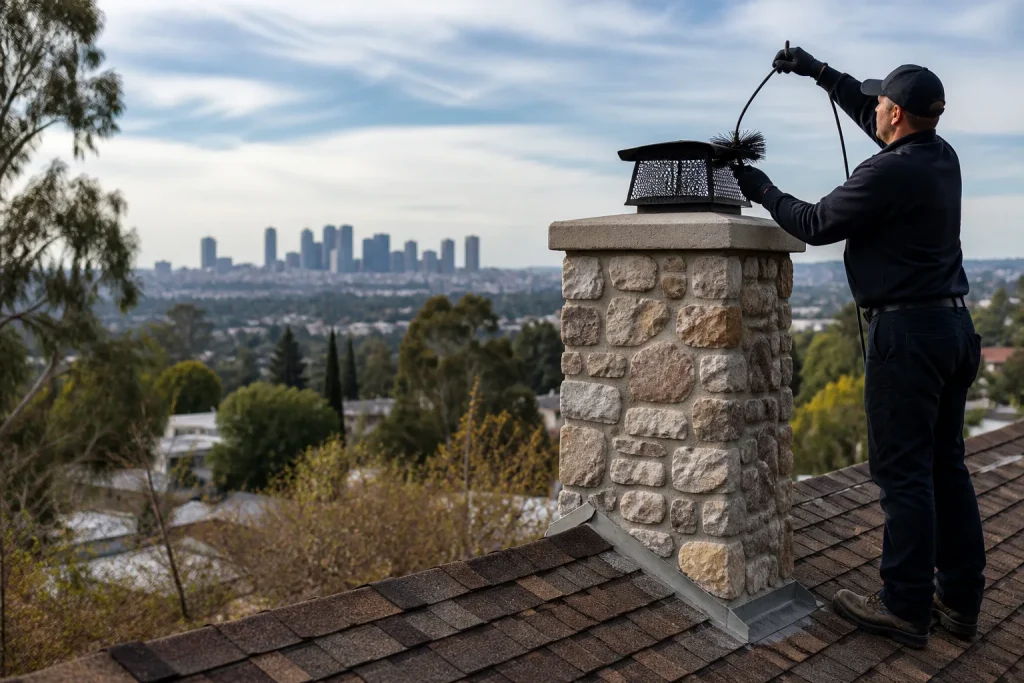
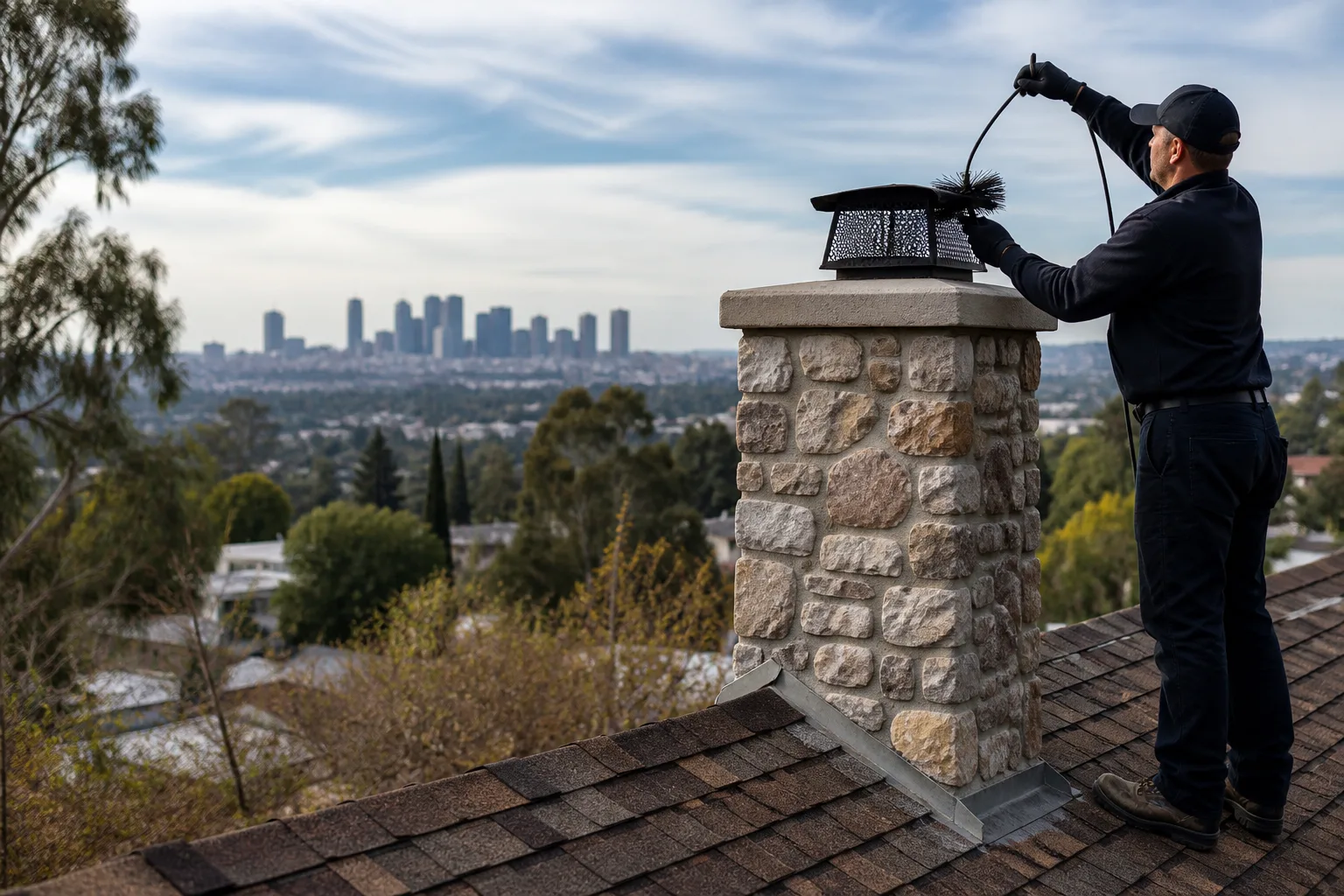
Preparing Your Home’s Chimney Cleaning for Winter in Los Angeles
Preparing your chimney for winter in Los Angeles means inspecting for debris, pest entry, and moisture damage before you worry about creosote buildup. Because most LA fireplaces sit dormant from February through October, the risk profile is inverted compared to colder climates: blockage and structural decay outrank soot accumulation. If you’d rather not handle the ladder work yourself, call (830) 251-4560 and we’ll send a background-checked technician to do it properly.
The average Los Angeles fireplace runs fewer than 15 hours a year. That sounds like low risk, and plenty of homeowners treat it that way: no visible soot, no reason to look. But a chimney that sits idle for nine months accumulates debris, pest nesting material, and moisture damage in ways a heavily used chimney actually doesn’t. Infrequent use has its own inspection requirements, and skipping them is how a small blockage in October becomes a smoke-filled living room the first cold night of the season.
We’ve cleaned chimneys across Los Angeles since 2002 as part of the Garrison Partners family, and the seasonal pattern here is consistent: the first Santa Ana winds push dust and dry leaves into uncapped flues, a roof rat or bird decides the flue is prime real estate over the summer, and by November the chimney that worked fine back in February has a problem nobody saw coming. This guide covers the prep sequence that matches how Los Angeles homes actually use their fireplaces.
Key Takeaways
- Dormancy between February and October creates debris and pest risks before creosote is even a factor.
- Santa Ana winds in fall push particulates into uncapped chimneys, making late October a high-risk period.
- Verify in writing exactly which tasks your sweep includes before the appointment.
- A post-cleaning report gives you a baseline for next fall, so changes are measurable.
- Mild LA weather masks problems: a chimney that hasn’t been used still needs inspection.
Why LA’s Chimney Risk Pattern Is Different
Most chimney maintenance advice is written for places where fireplaces run daily from November through March. That advice presumes creosote buildup is the primary concern, because heavy use produces heavy creosote. Los Angeles breaks that assumption. A chimney in Sherman Oaks or Pasadena that burns a few fires in December and January, then sits unused until the following Thanksgiving, rarely accumulates dangerous creosote thickness. What it accumulates instead is debris, insects, rodent nests, spider webs, and moisture-related masonry damage. Those problems don’t announce themselves with visible smoke stains on the damper. They sit quietly in the flue until someone lights the first fire and fills the house with smoke, or worse, a chimney fire starts from a bird’s nest acting as kindling.
The inspection order matters because of this. A standard pre-winter checklist in Chicago starts with creosote measurement. In Los Angeles, the first thing worth checking is what’s physically inside the flue and firebox after nine months of vacancy. We pull dried palm fronds, tennis balls, and roof rat nests out of LA chimneys every fall. Raccoons are less common in the basin than they are in the foothill neighborhoods like La Cañada and Altadena, but they show up often enough to take seriously. Birds, especially house sparrows and starlings, love an uncapped flue. None of this is a creosote problem, and none of it is solved by a routine sweep alone.
If you haven’t used your fireplace since last winter, the right sequence is: visual inspection of the flue interior for debris and nesting, then a creosote check, then a sweep if either is needed. Getting the order wrong means you might clean a chimney that’s still blocked, or worse, light a fire with a nest sitting five feet above the damper.
The Santa Ana Timing Issue Most Checklists Miss
Santa Ana winds typically start kicking up in September and October. They’re dry, they’re gusty, and they carry an enormous amount of particulate matter: dust, dried leaves, ash, and whatever else the chaparral and city streets release into moving air. For chimneys without a proper cap, or with a cap that’s loose or damaged, this is the highest particulate intrusion period of the entire year. A fireplace that was clean in August can have a thin layer of fine dust and leaf fragments coating the flue by late October.
This creates a scheduling quirk specific to Los Angeles. Homeowners who book chimney cleanings in early September are cleaning before the season’s biggest intrusion event. Homeowners who wait until late October are cleaning after it. Neither is wrong, but the late October appointment has an advantage: the technician is seeing the chimney at its dirtiest point, which means the cleaning actually addresses the full seasonal load. It’s the difference between washing your car before a dust storm or after it.
Our recommendation, based on thousands of LA service calls: if your chimney has a properly installed cap in good condition, schedule whenever fits your calendar. If you don’t have a cap, or you’re not sure, schedule your cleaning for late October or early November. You want the sweep to happen after the Santa Anas have done their worst. And if the inspection finds you’re missing a cap, that’s a repair worth making sooner rather than later, because the problem repeats every single fall.
What to Confirm in Writing Before the Appointment
“Chimney sweep service” means different things to different companies. We learned years ago that the only way to avoid disappointment is to specify the scope in writing before anyone arrives. Flint Chimney Sweep, along with every Garrison Partners location, follows a rule we call The Garrison Standard: the exact work, the exact price, and the exact guarantee all go in writing before a tool comes off the truck. You should expect nothing less from whichever company you call.
Here’s the minimum written scope a pre-winter cleaning in Los Angeles should include:
- Full flue inspection from the firebox to the termination point, including camera inspection if available. You want to know what’s above the damper, not just what’s in the firebox.
- Debris and pest removal as a separate line item. This is the LA-specific task that generic “sweeping” sometimes skips.
- Creosote assessment with a stated action threshold. How much buildup triggers a cleaning, and how much is safe to leave?
- Cap and crown check with photos. A cracked crown or missing cap is exactly the kind of finding that should come with visual evidence.
- Post-cleaning report documenting what was found, what was done, and the condition of the flue and firebox. This is your baseline for next year.
If a company won’t put the scope in writing, or the invoice shows surprise line items that weren’t discussed, that’s a signal. The number on the invoice should be the number you approved in writing beforehand. We’ve never made an exception to this in 23 years, and we don’t intend to start.
The Dormancy Trap: Why “We Haven’t Used It” Doesn’t Mean “It’s Fine”
Los Angeles has a mild climate problem, and it sounds like a compliment until you understand how it affects fireplaces. Because winters are short and never brutal, fireplaces sit unused for months at a time. Because they sit unused, homeowners assume they’re fine. The logic feels sound: no fire, no damage. But dormancy is its own risk category.
Moisture is the quiet culprit. Los Angeles doesn’t get much rain, but it gets enough, and it comes in concentrated bursts. A chimney with a cracked crown or compromised mortar joints absorbs water during January and February storms. That water sits in the masonry through spring and summer, doing the slow work of expanding and contracting with temperature changes. By the time you light a fire the following winter, interior spalling and flue tile damage may already be underway. None of it was caused by use. All of it was caused by lack of use combined with water entry.
Pests are the other dormancy factor. Roof rats are a real presence in Los Angeles neighborhoods, from the Valley to the Westside to the foothills. They’re excellent climbers, they’re active year-round, and an uncapped chimney flue looks exactly like a tree hollow to them. A nest that’s been built over the summer doesn’t dry out and fall away. It stays. The first fire of the season ignites it.
The takeaway isn’t that you should burn more. It’s that you should inspect based on calendar months, not usage hours. Just because you haven’t used the fireplace since February doesn’t mean you can skip the pre-winter check. Arguably it means the opposite.
What a Proper Pre-Winter Cleaning Should Leave Behind
The work isn’t finished when the brushes come out of the flue. The documentation step is where you either get lasting value or you don’t. A proper pre-winter chimney cleaning in Los Angeles should leave you with three things.
First, a written condition report. This should note the creosote level found, the type and quantity of debris removed, the condition of the flue tiles or liner, and the state of the cap and crown. If the technician used a camera, you should see the photos or video. We use camera inspection as a standard part of our chimney inspection service, not as an upsell. You can’t see above the damper from the living room, and a written report without visual evidence is just someone’s word.
Second, a list of recommendations with a clear priority level for each. Some findings need attention before you light the first fire. Others can wait a year or two. “Needs a new liner” and “monitor this hairline crack” are completely different statements, and you deserve to know which is which. If a company tells you everything is urgent, get a second look. A good sweep will tell you plainly when things can wait.
Third, a guarantee that covers the work performed. At Flint Chimney Sweep, every repair carries the 365-Day Done Right Promise: a written guarantee valid for a full year from the service date, and if a covered repair fails within that period, we return at no charge. No argument, no prorating, no callback forms. That’s The Garrison Standard in practice. If a company can’t tell you what happens when their work fails, that’s worth knowing before you hire them.
When to Call a Pro
There’s a line between what a homeowner can reasonably check and what should be left to a trained technician. You can visually inspect your firebox with a flashlight. You can look up the flue from inside the house. You can check for visible debris in the hearth area. But climbing onto a roof in Los Angeles, especially during fall when Santa Ana gust events are active, is not a homeowner task. Steep pitches, terracotta tiles, and sudden gusts are a legitimate safety hazard. We recommend leaving rooftop inspection and cleaning to a professional with the right equipment and training.
If you’re in Los Angeles and need a pre-winter cleaning, we offer Chimney Sweep in Los Angeles and Chimney Inspection in Los Angeles, both with written pricing before any work starts. If the inspection turns up something bigger, our Chimney Repair in Los Angeles service covers everything from cap replacement to full flue relining using professional-grade materials like DuraFlex and HeatShield, specified by job rather than by margin. This is what we’ve done since 2002, and we don’t cut corners on documentation.
The Bottom Line
Los Angeles fireplaces fail differently than fireplaces in cold climates. Less use doesn’t mean less risk: nine months of dormancy invites debris, pests, and moisture into the flue, and Santa Ana winds make late fall the dirtiest season for uncapped chimneys. The prep sequence for an LA home is inspection first, creosote assessment second, and cleaning third, with everything documented in writing. Specify the scope before the appointment, demand photographic evidence, and know what the guarantee covers and for how long.
If you’re in Los Angeles and want this done right, call Flint Chimney Sweep at (830) 251-4560 for a free estimate. Every job gets a written price before work begins, and every repair is covered by our 365-Day Done Right Promise. A live person answers the phone 24/7, so you’ll never wait until Monday to talk to a human.
Frequently Asked Questions
A standard chimney sweep in Los Angeles typically runs $180 to $340 depending on the flue condition, the amount of debris, and whether a full inspection with camera imaging is included. The price range is wider here than in some markets because LA chimneys often need pest removal and cap repair on top of the basic sweep. Add-on work like a new cap or crown repair is priced separately. At Flint Chimney Sweep, the written price before work starts is non-negotiable: the number on the invoice is the number you approved. Call (830) 251-4560 for an exact quote.
Once a year is the right baseline for most Los Angeles fireplaces, even though usage hours are low. The reason isn’t creosote volume; it’s debris accumulation, pest activity, and moisture damage. A yearly inspection catches a roof rat nest or cracked crown before it becomes a chimney fire or a $3,000 masonry repair. If you burn more than twice a week during the winter months, or if you burn green wood or use a wood stove, twice a year may be worth considering. The calendar, not the number of fires, is the better trigger for LA homeowners. Call (830) 251-4560 and we’ll tell you honestly whether you need a visit.
Not necessarily, and this is the single most common upsell in the chimney trade. Occasional use in Los Angeles produces less creosote and less heat stress than heavy use. What damages a liner in LA is more often moisture from a failed crown or a damaged cap than anything caused by burning. That’s why you want photographic evidence before agreeing to a liner replacement. If the camera shows significant flue tile cracking, spalling, or gaps, then yes, the liner needs attention, and a product like DuraFlex or HeatShield is the right fix. If the company won’t show you the photo, get another opinion. Call (830) 251-4560 for a camera inspection so you can see the flue with your own eyes.
The honest answer is that it depends on what’s in the flue, and you can’t know that without looking. In Los Angeles, a single skipped year is enough for a roof rat to build a nest or a Santa Ana season to dump a full layer of debris into an uncapped flue. If the flue is clean and capped, a year might be fine. If it’s not, the first fire of the season could be a chimney fire. The asymmetry matters: the cost of an inspection is modest, while the cost of being wrong is substantial. Call (830) 251-4560 and we’ll give you a straight answer based on what the camera shows, not based on a sales script.
Written by Hank Delano, Owner at Flint Chimney Sweep, serving Los Angeles since 2002.
Need Chimney Cleaning Help?
Call Flint Chimney Sweep - licensed & insured, here with fast after-hours help in Los Angeles.
(830) 251-4560